
Saffron Walden to Henham
Walking Log: Saffron Walden to Henham
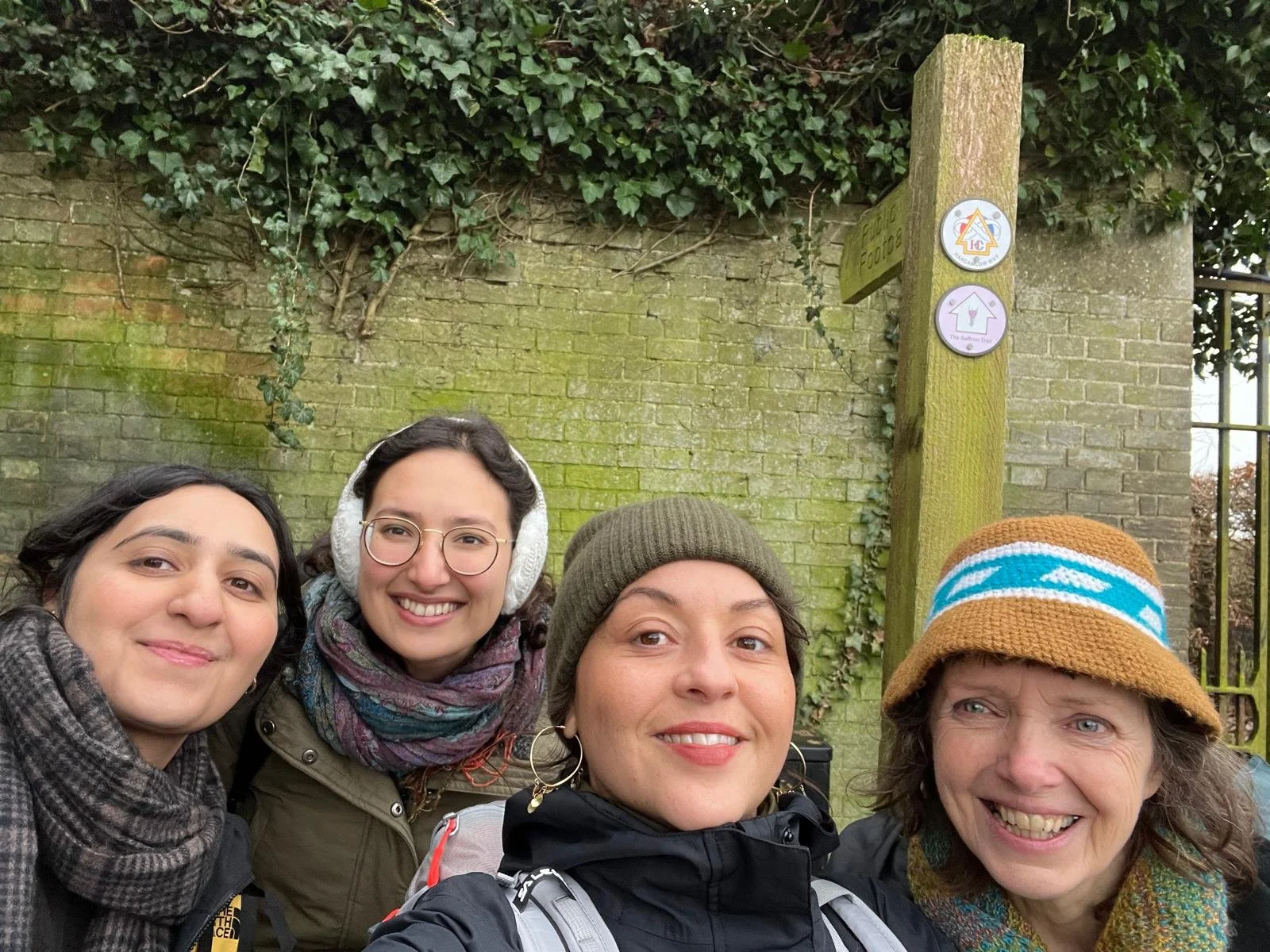
Walkers: Jess, Lora, Leela, and Saira
Distance: 11 miles
Settlements: Saffron Walden, Wenden’s Ambo, Newport, Widdington, Little Henham and Henham
Places of Interest: Saffron Walden Museum, Saffron Walden Castle, Saffron Walden Market, Chater’s, Audley End House, St Mary’s Church, Kappa House, Parish Church of St Mary the Virgin, Prior’s Wood, River Cam
Terrain: Mostly flat
Weather Conditions: Overcast, bouts of rain
Water Sites: River Cam and its small chalk stream tributaries, Debden Water and smaller brooks, agricultural drains and springs feeding into the Cam system.
Mood: Exploratory
Provocation: How do we ensure the trail feels like a welcoming 'front door' for the diverse communities within Saffron Walden? What are the barriers to minority engagement in this urban hub?
After a train ride, a bus journey, and a short walk, Leela and I arrive late to our meeting place, Chaters, an independent bakery and restaurant in the heart of Saffron Walden where Lora is expecting us. We order coffees and catch up while we wait for Jess, who arrives at the same time as our hot drinks. We’re kitted out in our waterproofs and boots, Lora and I with our hiking poles in tow. The four of us will be walking the Saffron Trail, in search of… what, we aren’t quite sure.
I’m excited and slightly nervous about the long, wet walk ahead of us. Following a knee injury and months of physio, it will be my first long-distance hike in a while. In previous years, I’d walked over five hundred miles testing out walking routes across the UK, from the backstreets of Bradford to the wild, open stretches of the Cambrian Mountains in mid Wales. I’m struck by how uncommon it has become to walk such distances in an age shaped by cars and other forms of transport - whether for wonder and wellbeing, or, as in our case, for research.
We spend a short time in the town before we head off for our walk. The bells of St Mary the Virgin Church ring as we approach - a reminder that we are here, and that our journey together on Blue Steps has begun. We briefly explore Saffron Walden Museum, one of the oldest purpose-built museums in the country which opened in 1835. We read up about local history and saffron – a spice that holds profound spiritual significance across multiple cultures and religions. A spice that somehow drew us all in.
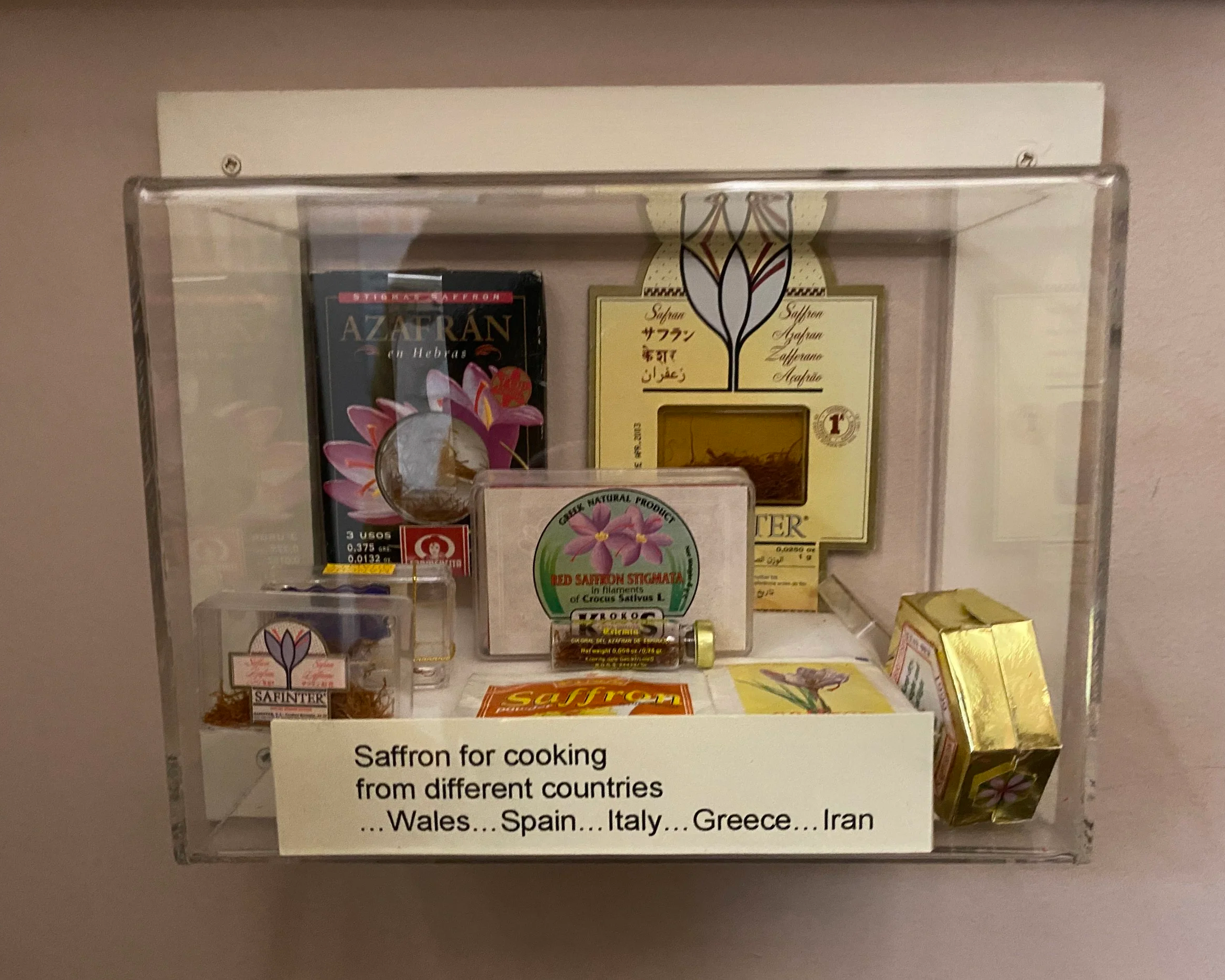
Wasn’t it a returning pilgrim who had smuggled a saffron crocus into the area in the 14th century? Local legend has it that he planted the bulb in Walden, where the crop thrived. The town became so prosperous from saffron cultivation that it eventually added “Saffron” to its name. ake it stand out
Saffron was extremely valuable in medieval Europe, and used in medicine, dyeing, cooking, and even as a status symbol. By the late Middle Ages, Saffron Walden was one of England’s most important saffron-growing centers. The purple bulb has since been an emblem for the town, a source of intrigue and identity.
Upstairs, the “world cultures” collection holds a carved Tahitian figure, a Zulu necklace, Samurai armour, and a waterproof parka made from seal gut from the Bering Strait. Objects taken by missionaries, soldiers, and colonial officers; a reminder of how connected this small town has been to the rest of the world.
After our short visit, we step outside and begin the walk through the high street of the North Essex market town, recently named the Sunday Times Best Place to Live 2025. Known for its rich history, independent shops, thriving food scene, and reputable schools, the town is also within commuting distance of London and Cambridge. The MP for North Essex is Kemi Badenoch, leader of the Conservative Party. Interestingly, the trail also passes through majority Labour and Liberal Democrat areas. I wonder how this will be reflected on the route.
We wander out of the town centre, and soon we reach a tall gate that opens out to a semi-rural path towards Audley End House. I wonder who feels comfortable enough to push it and cross the threshold from town into country. Who feels seen and who feels watched. Access is never neutral. The gate feels like a first barrier.
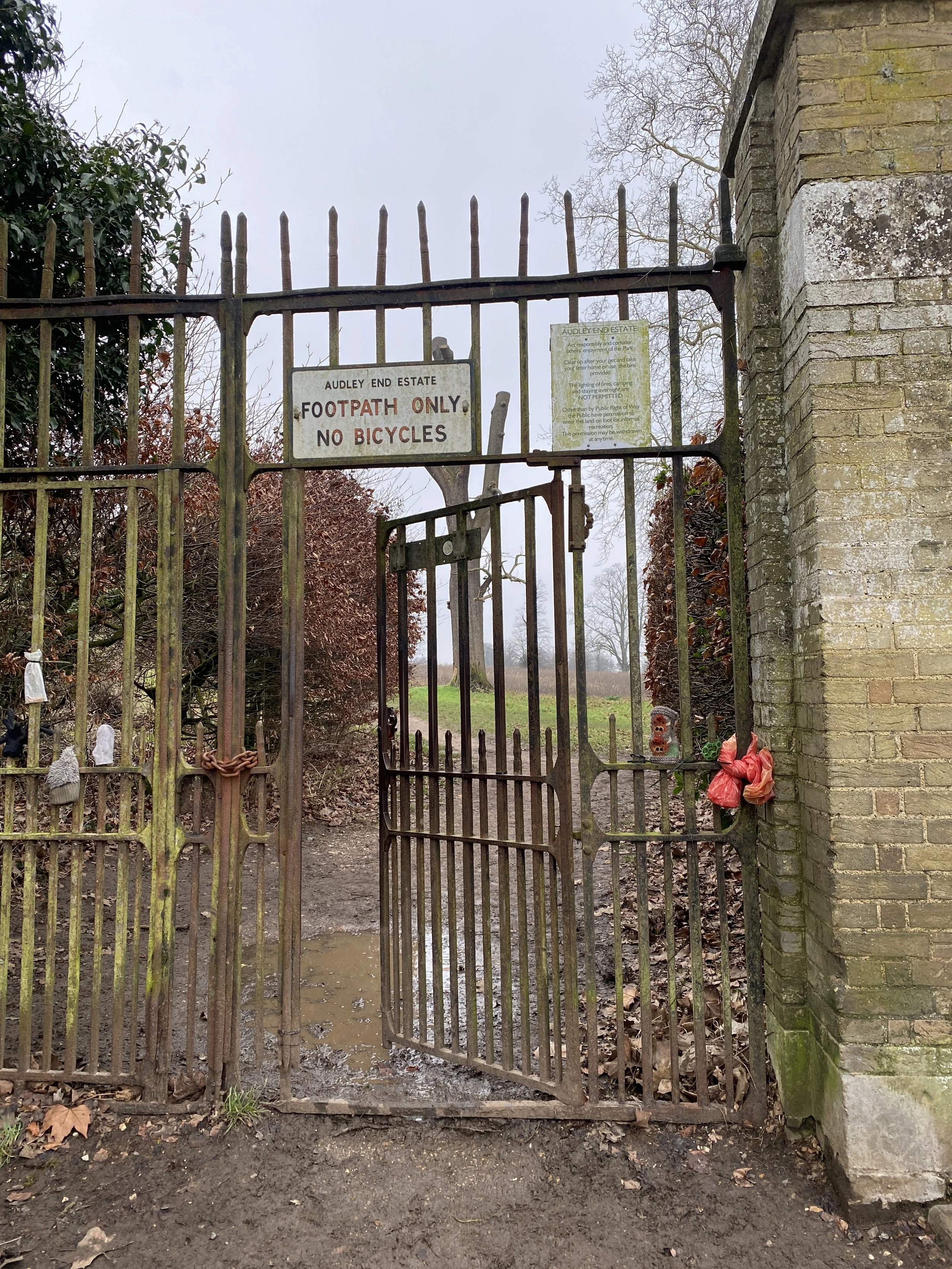
Beside the gate, a fingerpost, and the first purple crocus: our floral waymarker. As we reach the end of the path, we have a vote and decide to take our chances and cut across the Audley End House grounds, which runs parallel to the route and offers a scenic alternative to walking beside a busy road. We clamber over a low gate, some more graceful than others.
I think of how the land we are walking across is entangled with empire. Nearby, Audley End House stands as one of Jacobean England’s grandest mansions, its wealth interwoven with colonial administration and the transatlantic slave trade.
The land surrounding the home to some of the oldest trees in Essex. It’s not long before we reach another barrier, a soggy trench. We ask the staff on the other side if we can exit through the car park but are eventually refused. We turn around instead and head back, a half mile added to our journey. I’m a little nervous about timings, and whether we’ll be able to complete the route while it’s still light out, but the mood is still jovial. We get to know each other as we walk, we learn about each other’s work and lives and interests: mapping, ecology, politics, art, music, everything.
Soon we’re walking alongside a road, out towards the ancient settlement, and affluent village Wenden’s Ambo. We pass through fields, “Saffron Ice Cream,” “Saffron Security” - the crocus is everywhere, a symbol of continuity and connectivity. We continue to follow the trail, and soon we’re walking alongside the River Cam.
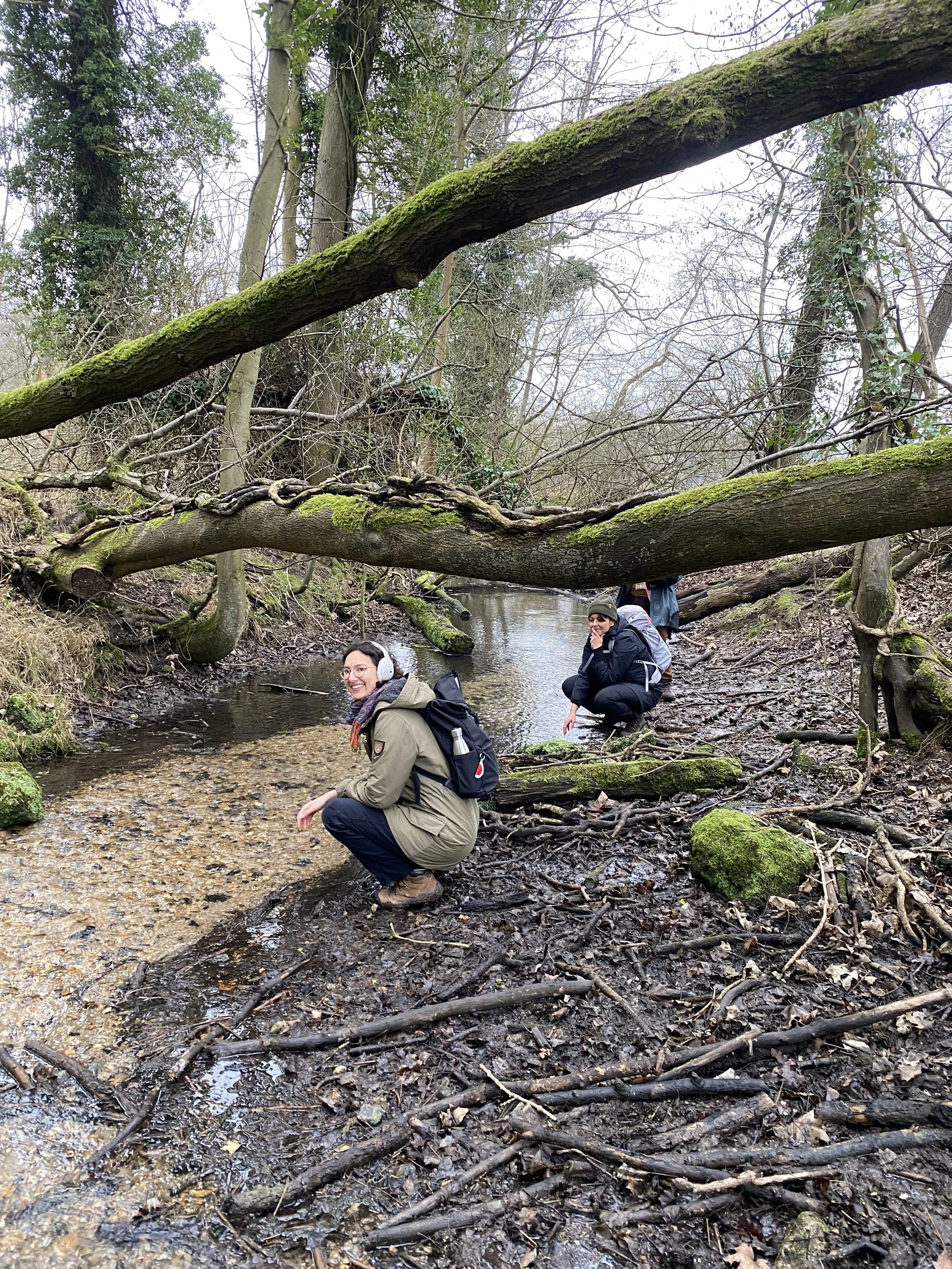
We stop briefly at a location where the fast-running water runs clear and bare trees bend over it. A quiet place to be with land and water. To feel alive and present. I’m reminded of the importance of water, of noticing and noting where it flows, and where it meets and diverges. Water to wash away, to cleanse, to cure, to drink, to drink, to drink – and to think, to formulate. Machine formulations, human and non-human. Water is the source. It feeds everything.
As we continue. I’m reminded also of deep time; things found in unlikely fields like the one we’re passing quietly through - ichthyosaur bones, fossilised horsetail ferns, Roman glass, and Anglo-Saxon rings. Soon we arrive at Wenden’s Ambo where each big and characterful cottage is adorned in pargetting and is a stretch away from its neighbour.
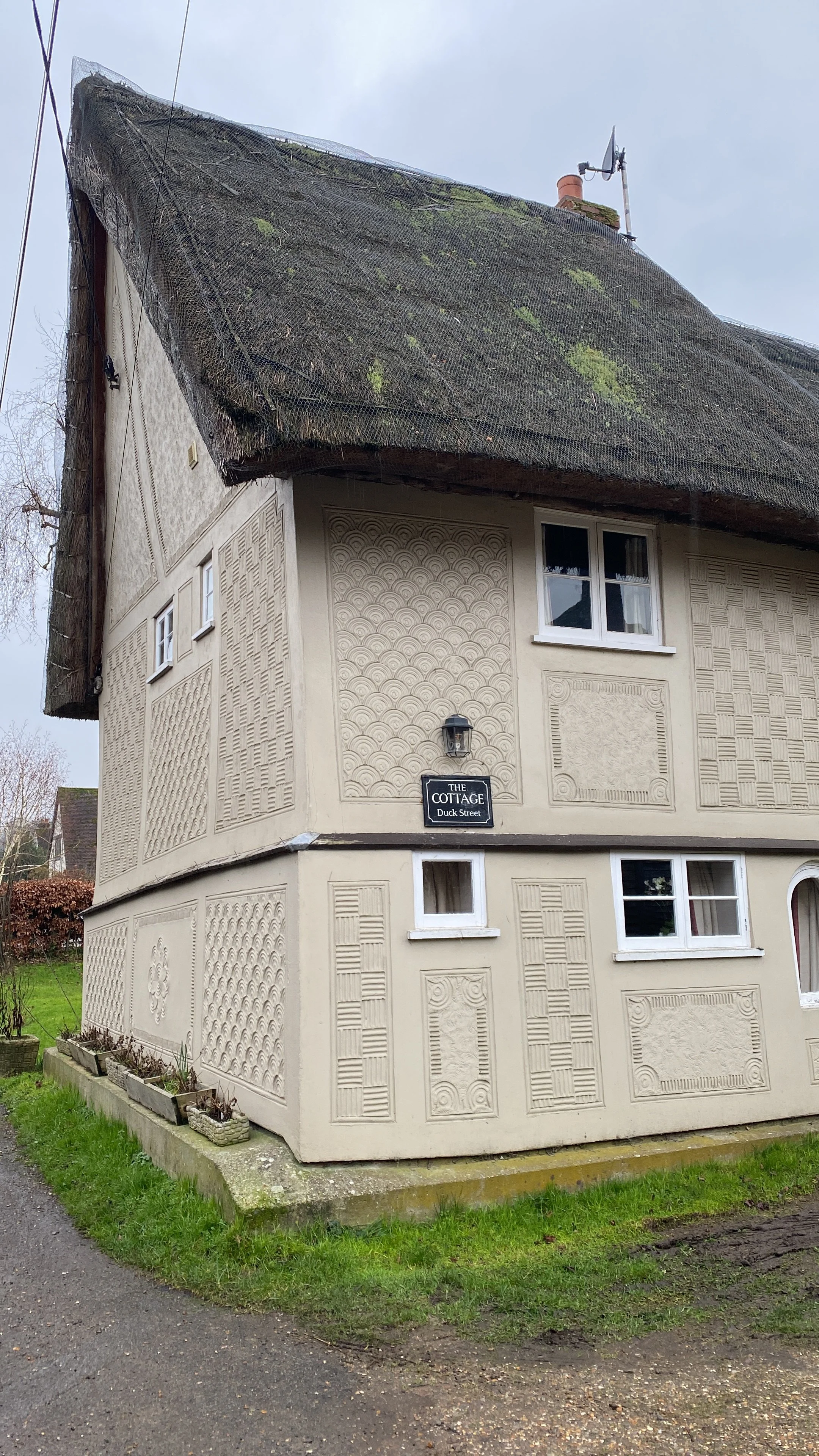
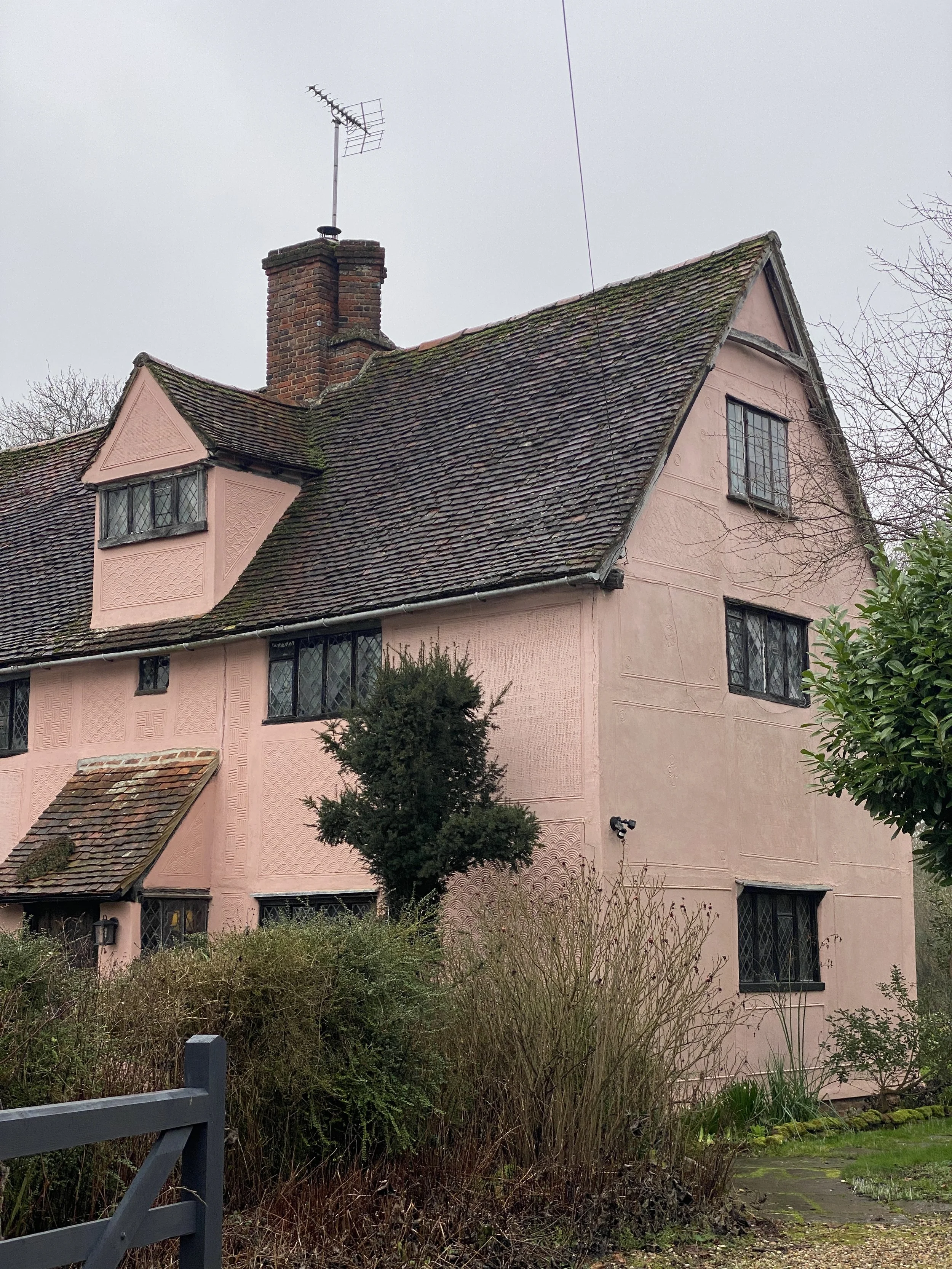
Pargeting the decorative, ornamental plastering of exterior building walls is primarily found on 16th-17th century timber-framed houses in Essex, Suffolk and Norfolk. It involves creating intricate, raised patterns, often floral, faunal, or figurative from plaster that acts as both protection and decoration. I wonder what modern-day pargetting might look like on other parts of the trail – what emblems would exist on plasterwork on a housing estate in Melbourne or Southend. And about related techniques for pargeting across different cultures: Awari in Japan, Yeseria in Spain and Latin America, Stucco in Italian, Gachbori in Iran.
How do craftsmanship and architecture separate us or enable a sense of belonging?
Almost all the driveways accommodate more than one car. I wonder about the demographics of who resides in each house, what they do and how they live. Water runs alongside us briefly, the River Cam and its chalk stream tributaries - Debden Water flowing quietly towards the next settlement. Sometimes you can hear a trickling before you can see it.
We cross the water and head towards our next settlement, passing through open land until soon the air is filled with the sound of school children playing in the grounds that hug the trail. We reach our next settlement, Newport, a historic village situated in the Uttlesford district, in time for lunch and, fortunately, just before the rain comes down. We find shelter on the porch of 13th-century St Mary the Virgin Church and devour our packed lunches; a mix of marmite cheese sandwiches, boiled eggs, hummus, crisps made with potatoes grown in British soil and chocolate; its beans sourced from Ghana.
After lunch, we are revived and ready to complete the rest of the walk – but before that, we need hot drinks to warm our cold bodies. In a converted cosy barn on the high street, Kappa House café sells home-cooked sweet and savoury gems. Lora and Leela buy date biscuits; we share them, they’re delicious. We also buy hot drinks. The barista tells us she sometimes walks from Elsenham in summer. There’s only one other person at the café that will soon close, a young black man finishing his meal. I wonder if he’s a local, and if he uses the trail.
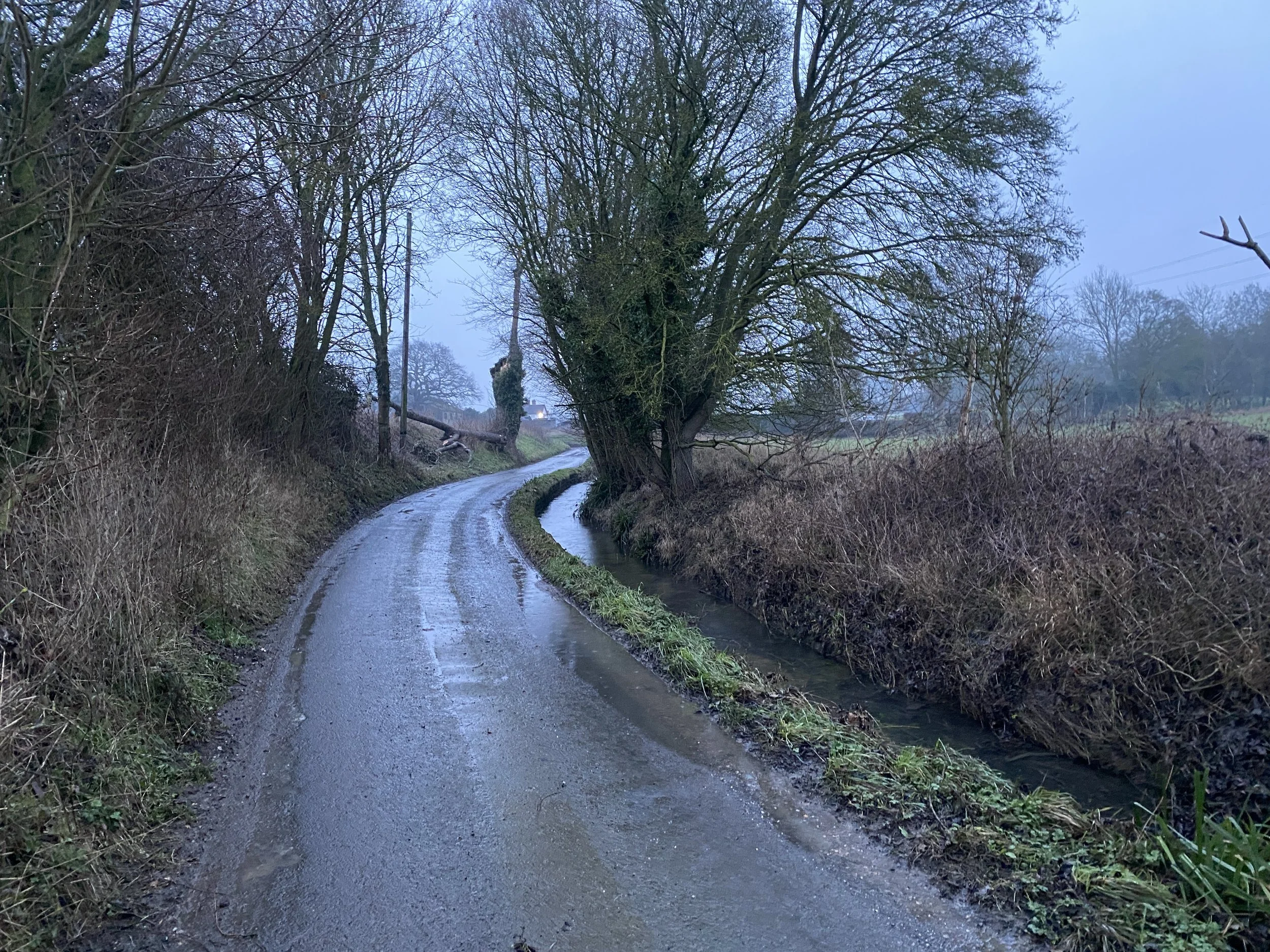
It’s late afternoon when we set off to complete the walk. Hopeful we can make it to Henham, though as we pass a train station, our first since we started walking, I wonder if it would be defeatist to call it a day. The rain is falling, and the path that continues on the other side is muddy. We keep going, across fields, and through Priors Wood, where the gnarly trees are living and dying.
I think again about barriers on the trail. I think about the lack of rest stops, benches and shelters on the way, the lack of frequent and reliable public transport connections to and from the villages we pass through. I think of rickety stiles and sinking ground. We’ve barely come across anyone on the trail, perhaps a dog walker or two. Maybe there is more footfall in warmer months. The land is seeped with water following the wettest January on record.
We exit the forest and its fields again. It’s getting wetter and takes all my concentration to navigate. The sky begins to darken. Even as an experienced map reader and hiker, I still overshoot, so often it’s embarrassing. I miss the waymarkers. I wonder if the dyspraxia and ADHD make it harder for me to stay on route and to stay present. Again, I think about accessibility and access - about who walks and who doesn’t walk, and why.
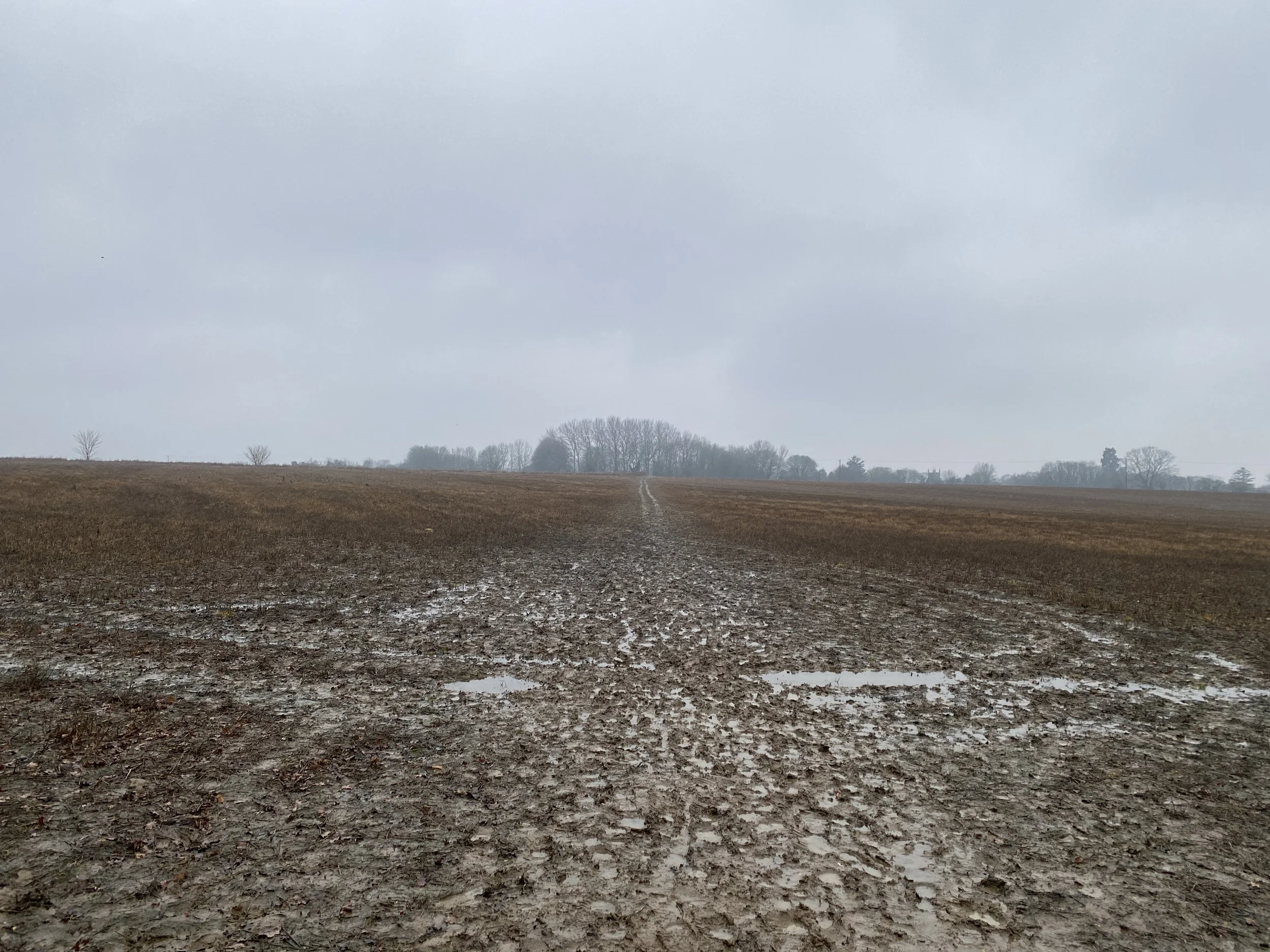
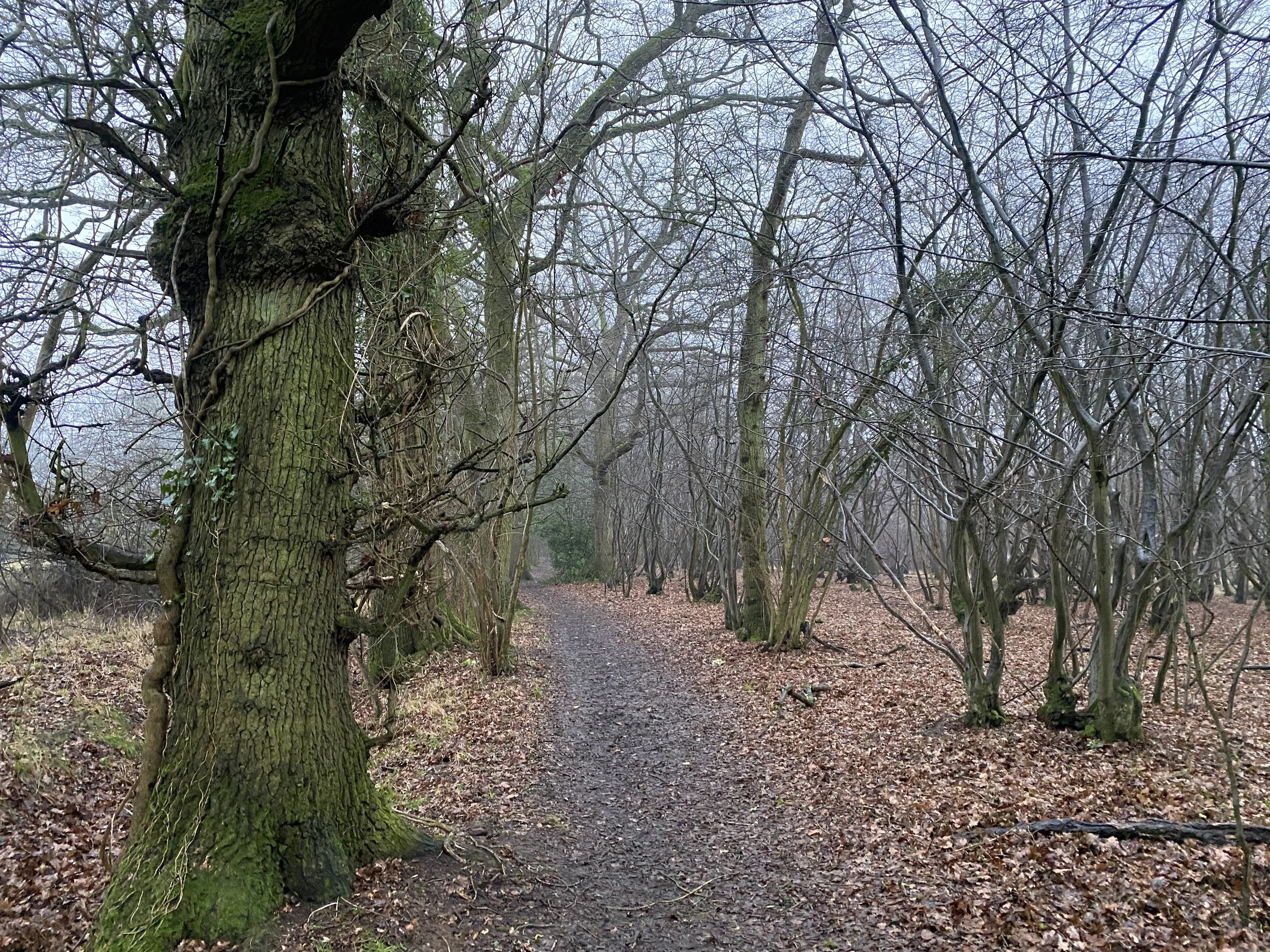
What other barriers exist? A lack of time and funds to undertake a journey? To plan for it. The unaffordability of good quality kit? Boots and poles, waterproofs. A shortage of skills required or perceived to be required? Suspicion of the unfamiliar. The potential of being met with hostility and threat? Racism or xenophobia. A bad-tempered dog. A sense of unease… present, and intangible.
I feel thrilled that we’re approaching the end – but whose idea of joy is this? Traversing long wet muddy distances on foot.
I remember when a friend, a refugee seeking a safe place told me of his experience walking beside a farm, and becoming hemmed in, and then attacked. Who decides what a safe space is? He found long-distance walking triggering - a necessity during a stretch of life he’d rather forget.
I think of the group from Black Girls Hike being called unfriendly and miserable by passers-by for walking in silence on a meditative walk. Muslim hikers receiving torrents of online abuse. Women who have been attacked while walking. Who is kept out of the countryside? Who feels excluded? Who feels unsafe?
Our experiences of trails are not the same.
I read that it was a man named David Hitchman, a member of the Ramblers, who created the trail in 2020. There were no walking trails that ran from North Essex to South Essex so he devised one. I wonder how he chose which paths to use, which places of interest to include. I got in touch with the Ramblers, and eventually a friendly and forthcoming man named Peter provided me with some more information. He told me a group of fifty ramblers, had walked the whole trail. I wonder what their experience was like. Peter said he would share his photo book archiviving the walk at the upcoming Blue Steps Climate Justice workshop taking place at Belfairs Nature Discover Centre.
A couple have also mapped the route on the Kamoot app. We’ve been following it, as well as following segments of the route shared on the Visit Essex website by a man named Stephen Neale who recalls his journey through his own series of walking logs. Upon further research, I discovered that Stephen is an award-winning author, journalist and adventurer. Obsessed with walking, he is the author of The England Coast Path and The South West Coast Path and Camping by the Waterside. I wonder what a co-produced trail might look like, in which different kinds of people shared what places they’d like to stop off at, and what a place of interest might look to them.
I think of walking, and others who have walked and why they have walked. A woman in recovery from drug addiction traverses the South Downs. A friend in her sixties, gay and Catholic, walks the Camino in search of her lost voice. Pilgrims circling the Kaaba seven times. I think of the refugees who traverse entire countries by foot. The black people, primarily African students and residents, who were forced to walk at the outbreak of war in Ukraine while others boarded trains.
Walking can be humiliation. It can be survival. It can be devotion. It can be reclamation. It can bring clarity, even epiphany.
What makes walking unique? Perhaps it is its ordinariness. It is so every day that we rarely question it - yet it carries history, power, exclusion, survival, and transformation within it.
Throughout the walk we ideate out loud, we dream and imagine - we think about what could exist. Chai and chat wanderings for elders, a bird hide to shelter in, a caravanserai of some kind, a colourful welcoming bothy – or toilets, benches, a library of walking things where people can borrow supplies. Maps and raincoats, waterproof boots and trousers. Travel stipends for well-being walks in the countryside. Training in reading maps.
If the Saffron Trail is to be a front door, its stories - of empire and abolition, of saffron and spice routes, of land and water - need to be surfaced. Perhaps guided walks led by those from marginalised communities; partnerships with local schools, community centres, mosques, temples and churches; multilingual maps; circular routes designed with mobility in mind.
What will our future relics be? Solar farms? Flood barriers? Community Centres? Cultural spaces marking demographic shifts? The trail feels ordinary - fields, flint, mud - but maybe its ordinariness is its power. It doesn’t declare itself spectacular. It invites you to wander, and observe, to feel embodied.
Most of all, it requires a shift in imagination. To think of all the different people who can use the trail for so many different purposes. During my years walking, some encounters stuck: a West African nun on the path beneath a windmill near Kingston. A Chinese man singing in his mother tongue whilst passing through the ruins of Lewes Castle. An Indian student praying at the Chattri in the English countryside. Women walking alone without fear in remote stretches, passing through graffiti-covered underpasses and over hills. It’s to recognise that belonging isn’t inherited like a stately home; it is practised, step by step.
By the time we reach St Mary the Virgin Church in Henham, dusk is closing in. We have walked eleven miles in five hours later. Caked in mud. The sky has been expansive and unfettered. We have walked through wealth and water, history and hedgerow, pargetting and pillboxes. The trail has blurred into field, mud, field, mud - and yet something has clarified.
A front door is only welcoming if it opens easily, if you believe you are allowed to cross its threshold. I wonder if the Saffron Trail holds that possibility.